

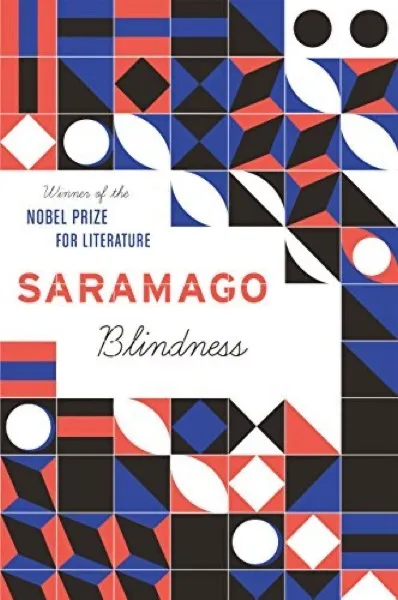
📚 Blindness
Genre: Dystopian Fiction, Literary Fiction Originally Published: 1995
💭 Quick Summary & Thoughts
Let me start with a warning: this is a dark read. Not Haunted-by-Chuck-Palahniuk level dark, but it’s a book you want to be prepared for before diving in. Midway through, things happen that come out of the blue, though knowing the hierarchy of needs, maybe they’re not entirely unexpected.
That caveat aside, this is a well-crafted book. The premise is simple: a contagious virus that causes blindness sweeps through a city, and Saramago uses it to ask how humans would actually behave when everything we take for granted falls away. I thought it was a remarkably apt description of how things would play out. Written in 1995, it reads as though it could have been written today, which is both impressive and a little unsettling.
I do have a couple of gripes. First, the ending is weak. The author could have done so much more with it, but the pull toward a tidy, hopeful close never quite lets go. Second, one of the lead characters, someone I really liked early on, does something so far out of character that I couldn’t wrap my head around it. It didn’t further the plot or serve any purpose I could see. (More on that in the Spoiler Zone.)
Beyond those, this is a solid book. The character development is excellent. It’s a translated work, but it never feels translated, the writing is largely smooth. One quirk worth flagging: almost none of the characters are named. They’re identified by distinctive traits instead, which I found a little weird at first but never hard to follow. And honestly? This would be a fantastic book club pick. There are so many discussion points packed in here.
⚠️ Spoiler Zone
🚨 Click to reveal spoilers 🚨
Onto the specifics. The book starts off so strong: a man loses his sight in the middle of the street and is promptly robbed by the seemingly good samaritan who helps him home. The government’s reaction once they understand the scale of the problem is depressingly typical, quarantine the infected in a mental hospital with almost no coordination around food or sanitation, and give the army shoot-to-kill orders for anyone who tries to flee.
Inside the hospital, things go from bad to worse, scarcity of food, no hygiene, total breakdown. Saramago doesn’t shy away from the gory, disgusting details of life in there, and that only adds to the experience. Then the book takes an even darker turn. A group of bandits exploits the absence of any law or order, confiscating food and valuables, and then, inevitably, demanding the women. I’d been bracing for something like this, but wasn’t sure the author would actually go there. He did. And I hate to admit it, but that is probably how hooligans in that situation would behave. To the residents’ credit, the man with the eye patch leads a charge of mutiny, but as blind men against a gun, they never really stood a chance.
The doctor’s wife is clearly meant to be the protagonist, and her arc is one of the best I’ve ever read. She starts as a devoted wife, going so far as to enter quarantine alongside her husband and hide her secret of still being able to see. She does what she can to help the others, even the robber, who in my opinion gets exactly what he deserves for being handsy with the girl with the dark glasses. But here’s what infuriated me once the bandits took over, and what I think I finally understand: why didn’t she just kill their leader before the women were defiled? She could have done it easily, even earlier. But I think that’s the whole point, that’s who she was. A docile, pacifist woman doesn’t go around murdering people. It’s only after that horror that something shifts in her and she finds herself capable of the deed. The atrocity is the hinge her entire character turns on. And even once they’re out of the hospital, she keeps being the group’s eyes and its conscience, holding everyone together. It’s a beautifully complete arc.
Which brings me to the one thing I genuinely couldn’t forgive. The doctor, of all people, sleeps with the girl with the dark glasses, and then tries to reason it away to his wife, who simply asks him not to mention it again. Up until that point his character had been exactly what it should be, steady, decent, the moral counterweight. And then the author throws this in. It doesn’t further the plot, it doesn’t deepen anyone, it doesn’t pay off later. It just sits there as a stain on a character who didn’t need one. That was the out-of-character turn that took me right out of the book.
Once the residents finally leave the hospital, the world outside is no better. People can’t find their own homes, feeling their way around and scrounging for food. Hard-hitting, but plausible.
Amid all that bleakness, there’s the dog of tears, and it might be my favourite thing in the whole book. When the doctor’s wife finally breaks down and weeps in the rain, a stray dog comes and laps at her tears, and then simply stays, padding alongside the group from that point on. It’s such a small thing, and it wrecked me a little. In a world where every human bond has been tested and most have curdled, the one source of pure, uncomplicated comfort turns out to be an animal that asks for nothing and gives everything. Saramago never sentimentalises it either, the dog is just there, loyal and undemanding, and somehow that says more about tenderness than any of the human relationships in the book.
The other moment that has stayed with me is the church. Late on, the group shelters in one, and the doctor’s wife realises that every holy image, every saint, every painted figure of God, has had its eyes covered, painted over or bound with a strip of white cloth. And it wasn’t decay or accident, someone had climbed up and done it deliberately, image by image. It’s such a quietly devastating idea, even the divine has gone blind, and a human being chose to make it so. Faith, in the end, is just one more thing we keep asking to see and can’t. It reframes the entire novel in a single page, and it’s the part I keep turning over.
Those two moments aside, though, the final stretch does coast, visiting their houses, the girl with dark glasses leaving a note for her parents, the encounter with the old woman eating raw chicken, the writer living in the couple’s home. It’s all fine, but it doesn’t add much. I think a time jump, ten years into the future, would have been so much more impactful. I’d like to think there would have been self-sufficient blind people teaching others their skills, a society genuinely transformed. Instead we get an ending where sight simply returns, and the doctor’s wife goes blind, the signal that it was only ever a transient virus that would pass.
💬 Quote Corner
“I don’t think we did go blind, I think we are blind, Blind but seeing, Blind people who can see, but do not see.”
“Inside us there is something that has no name, that something is what we are.”
⭐ Ratings
| 📊 Plot | |
| ⚡ Pacing | |
| 👥 Characters | |
| ✍️ Writing Style | |
| 🎯 Overall |