

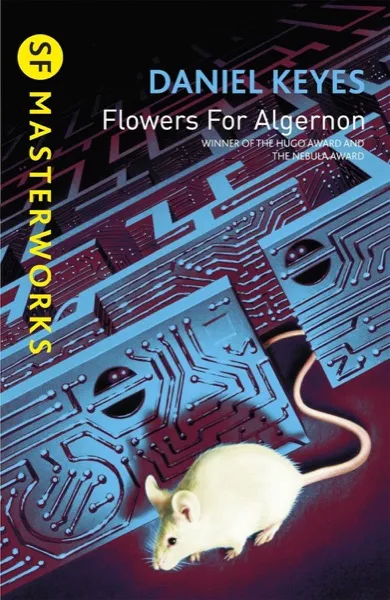
📚 Flowers for Algernon
Genre: Fiction, Classics, Science Fiction Originally Published: 1966
💭 Quick Summary & Thoughts
I usually write my book reviews before the book club meeting, so my thoughts are on record before I’ve had a chance to be influenced by anyone else. This time I just didn’t find the time, and I’m writing this two book club meetings later. Two, you ask? One for my Books & Brew book club, and one for the Supabase book club. The fact that this book got picked for two separate book clubs, without any interference from me in the democratic process, I must add, should already tell you a lot about it.
And with that disclaimer out of the way: this has honestly been a wonderful read. It’s probably the only book in my Goodreads library that I’ve rated 5 stars, and so have all my friends who’ve read it. A book that clears the first bar is rare enough; to be so universally loved, you have to have written something special. There are hints of misogyny and some regressive thinking in here that keep it from reaching the heights of To Kill a Mockingbird, but for a book written in that era, it has survived the test of time remarkably well.
Apart from a few teeny-tiny nitpicks, I love almost everything about it. Writing the entire thing as progress reports from Charlie is a masterstroke, and it’s also exactly why this book should be read on the page, not heard as an audiobook. I’m glad I was warned off the audio version, otherwise I’d have lost so much of the book’s substance.
⚠️ Spoiler Zone
🚨 Click to reveal spoilers 🚨
Like I said, writing the book as Charlie’s progress reports gives us an unadulterated look into his mind and life. His early logs use extremely simple words, riddled with spelling mistakes (and yes, that’s exactly why you need to read this book and not listen to it — otherwise you miss all the misspellings), and equally simple thoughts: he wants to be smarter because he thinks it’ll get him more friends, make his teacher happy, earn him praise from everybody. Charlie’s simpleton nature shows through in the way he doesn’t realize when he’s being taken advantage of or made fun of. He just wants to get along with everyone, so he ends up laughing along even when he’s clearly the joke. The book makes you feel angry on Charlie’s behalf, and I’m guessing that’s intentional.
Then Charlie has his operation, and you go through the journey of becoming smarter right alongside him, and it’s so well explored. It starts slowly, with better spelling, a better understanding of the world and himself, until he finally reaches a point where he starts trusting himself and his intelligence. As a reader you keep hoping that the smarter Charlie gets, the better his life will become, but the opposite happens. He grows disillusioned with the world and with the people he once placed on a pedestal. He realizes Nemur and Strauss aren’t all-knowing either, and have faults of their own. The intelligence Charlie chased his whole life doesn’t give him what he thought it would. And that felt so relatable, because we’re all like that, we chase things believing they’ll lead to some better life, or whatever outcome we’ve built up in our heads, but once we get there it seldom turns out to be what we hoped.
The aspect we really latched onto, and explored at length in book club, was IQ vs EQ. Early on Charlie has very little IQ, yet his thoughts and actions are always so considerate towards others. The smarter he gets, the more selfish (in a sense) he becomes. He grows increasingly hard to be around and to talk to. He cares very little what others feel or think, behaves poorly with Alice, and even shows up Nemur at the conference. It raised the question: does it have to be this way, where highly intelligent people end up emotionally stunted? History is full of the exact same story, most recently I saw it in The Maniac with John von Neumann, but there’s also Tesla, Van Gogh, and so many who came before them. We honestly didn’t land on an answer, but it was good food for thought.
The one character Charlie shows sincere empathy towards is Algernon. That was refreshing to read, and the whole scene with his escape was hilarious and heart-warming, but I was disappointed by how small a role Algernon plays overall. I’d hoped that once they escaped together, it would be the start of a partnership, Charlie trying to communicate with Algernon, giving him yes/no buttons and actually holding a conversation with the mouse. But none of that happened. Maybe I’ve been spoiled by Project Hail Mary and I’m expecting too much, but I was really looking forward to it, and I’m not gonna lie, I was let down when it never came.
Then there are Charlie’s relationships, with Alice and Fay, which unfortunately don’t add much for me, especially the latter. With Alice I get it: the backstory, the way their relationship starts and then crumbles when he becomes too smart for her. It made us ask whether you have to be just as smart as your partner for a relationship to work. We had differing opinions, but I landed on this: you don’t need to be equally smart, but the gap can’t be too wide, because otherwise you just can’t communicate properly. The book explores this beautifully, Alice and Charlie only work when they’re at roughly the same level. Fay’s relationship, on the other hand, felt pointless and meaningless to me, along with the whole reverting-to-old-Charlie-when-he-drinks thread. I don’t know what any of it contributed. I could have lived without it.
Speaking of relationships, the exploration of Charlie’s childhood, and how his parents dealt with the situation, gives you a glimpse into how hard it is on the parents too when they have a mentally challenged kid. I don’t agree with how Charlie’s mother went about things, but I can understand that she just wanted what was best for him and wanted him smarter by any means necessary. Accepting reality was clearly too much for her, unlike her husband, and that eventually led to their divorce. It was just a very sad story. Another thread that spun out of our discussions was whether it was selfish of Charlie to go and try to meet his parents. I thought it was, they were already under the impression that he’d passed away, so why show up alive and smart, only to tell them it’s all going away soon and he’ll be back to being just as dumb, if not worse off than when he started? That’s ripping a bandaid off an old wound. Charlie ultimately doesn’t tell his father, but he does tell his mother, which is something I probably wouldn’t have done in his shoes.
And finally, his journey back down from intelligence. Even once we knew about the Algernon-Gordon effect, it was excruciating to ride it out with him. Charlie even contemplates suicide at one point, and we discussed this in book club too, almost all of us understood, on some level, why. Losing your intelligence felt almost life-ending. What’s the point of life if you can’t even remember the experiences you’ve had or look forward to anything? To me it felt like Charlie lost in both directions. On the way up, the disillusionment and isolation caused by his sudden change cost him his friends (though it’s debatable whether his bakery co-workers were ever really friends), and he realized it was all for naught. What he wanted, he never got. And on the way down, there’s the powerlessness in the face of the impending doom of becoming stupid again. He doesn’t deal with it well: he trashes the books he was once able to understand and behaves cruelly to Alice. Ultimately, if you compare before and after the experiment, Charlie ends up right where he started in terms of intelligence, except now his relationship with his bakery colleagues is destroyed, and he can’t even go back to the school he attended before, because his relationship with Alice has changed. And that, to me, sums up this book in the most complete sense. How heartbreaking that entire journey is.
💬 Quote Corner
“P.S. please if you get a chanse put some flowrs on Algernons grave in the bak yard.”
“I don’t know what’s worse: to not know what you are and be happy, or to become what you’ve always wanted to be, and feel alone.”
“I am afraid. Not of life, or death, or nothingness, but of wasting it as if I had never been.”
⭐ Ratings
| 📊 Plot | |
| ⚡ Pacing | |
| 👥 Characters | |
| ✍️ Writing Style | |
| 🎯 Overall |