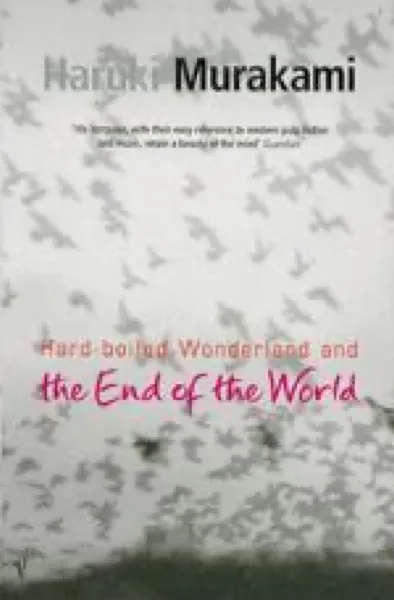
📚 Hard-Boiled Wonderland and the End of the World
Genre: Fiction, Science Fiction, Magical Realism, Japanese Literature Originally Published: 1985
💭 Quick Summary & Thoughts
For the first stretch of this book, I genuinely could not tell you what I was reading or why, and I’ve since made peace with the idea that that was probably the point.
This was my first Murakami, and it threw me. I couldn’t make head or tail of what was happening early on, and it was unnerving enough that my progress slowed to a crawl, I kept circling back to reread chapters, trying to work out how each one connected to the whole. Then, slowly, things began to click, and I started to suspect this is just how he writes. Once I made my peace with that, the rest was smooth sailing.
The book sits in this odd middle ground between science fiction and Japanese literary fiction. You get a window into a Japanese way of living and into the protagonist’s interior world as things unfold, but honestly, the Japanese setting itself doesn’t do much heavy lifting, you could relocate the whole thing to America, or just about anywhere else, and very little would change. And the science-fiction half is there too, but it’s largely hand-waved, given a sliver of explanation and not much more.
Overall, it was an okay read. Given how revered Murakami is, I’d like to believe this isn’t his peak and that there’s better waiting for me. If anything, I’m glad I’ve now got a feel for his style, so I know what I’m walking into next time. I’ll be back for more, just with clearer expectations.
⚠️ Spoiler Zone
🚨 Click to reveal spoilers 🚨
Like I said up top, those first few chapters were jarring, two stories running in parallel, neither of them making much sense. On one side, a man arrives at a strange walled town at the End of the World and is promptly stripped of his shadow, with the Gatekeeper laying out the rules of the place. On the other, a Calcutec heads off to a new job. He’s in an elevator counting coins, wondering whether he’s going up or down or has made a full revolution around the Earth, contemplating what would happen if he were simply left there and the doors never opened, then counting the coins in his pockets again. What a way to open a book.
That early scene where he coughs and momentarily can’t find his voice, testing whether something’s wrong with his throat or his ears, turned out to be excellent foreshadowing. Then he meets the grandfather’s granddaughter, the chubby girl in pink, who guides him through to the lab and ends up being his main companion for the back half of the book, and we get the protagonist’s bizarre internal monologue about heavyset women and the precise conditions under which he does and doesn’t find them attractive. Weird as hell. By the end of those first five chapters, I was completely lost, no idea where any of it was going, what these people were doing, or what the story even was.
Slowly, the fog lifts. One half of the book turns out to be about information warfare: the Calcutec’s job is to encrypt data, and our protagonist has been hired for exactly that by the grandfather, an old scientist. We learn about the warring entities, the System and the Factory, and the conflict raging between the two factions. Then comes the strange thread about bones and the sounds they make, and the silencing of them, which, while it adds a layer of mystique, ultimately plays little to no role. As we eventually find out, this is really all about the protagonist and the world inside his own head, the one he’s about to get swallowed by. But in the moment it feels like it’s building toward something, and the protagonist assumes the same, so after a “scrambling” job and being gifted a unicorn skull, he seeks out the librarian and enlists her help to figure the skull out.
In the second story, the other protagonist has become the Dreamreader, and he too meets a librarian who helps him get started, reading old dreams out of the skulls. He meets his shadow, and we learn that the shadows are what hold a person’s memories and sense of will, once your shadow dies, you become a placid, thoughtless part of the town. So, at his shadow’s urging, he sets about secretly mapping the town in the hope of escaping it.
The first story keeps barrelling along: hooligans show up and trash his apartment, and he and the granddaughter go on the run, descending into the dark tunnels beneath Tokyo and picking their way through territory crawling with the INKlings, the eerie subterranean creatures both the System and the Factory live in fear of. It’s a genuinely gruesome stretch, and it ends with the big reveal: the protagonist has been one of the grandfather’s experiments, the sole survivor of 28 subjects, originally operated on to make the scrambling possible. The catch is brutal, the procedure left a dormant “third circuit” buried in his brain, and the grandfather drops the bombshell that it’s about to switch on for good. Within roughly a day and a half, his conscious self will shut down and he’ll be sealed permanently inside the world in his head, no way back. The second story, the one running in parallel, has been unfolding in exactly that place all along. Both protagonists are the same man.
With the clock run out, the book closes on his final choice. His shadow finds the way out, but the protagonist decides to stay behind in the End of the World, accepting the town and the people he’s dreamed into it as his own responsibility, rather than taking the escape sitting right there on the table.
There are genuinely unique and thought-provoking ideas in here, the notion of carrying an entire world inside your own head, or of a single instant before death stretching out into infinite moments that keep subdividing forever. But on the whole, it’s a weird book that keeps you faintly uneasy the entire time you’re reading it. Maybe that unease was exactly what Murakami was going for.
💬 Quote Corner
“You got to know your limits. Once is enough, but you got to learn. A little caution never hurt anyone. A good woodsman has only one scar on him. No more, no less.”
“Life’s no piece of cake, mind you, but the recipe’s my own to fool with.”
“Two people can sleep in the same bed and still be alone when they close their eyes.”
⭐ Ratings
| 📊 Plot | |
| ⚡ Pacing | |
| 👥 Characters | |
| ✍️ Writing Style | |
| 🎯 Overall |