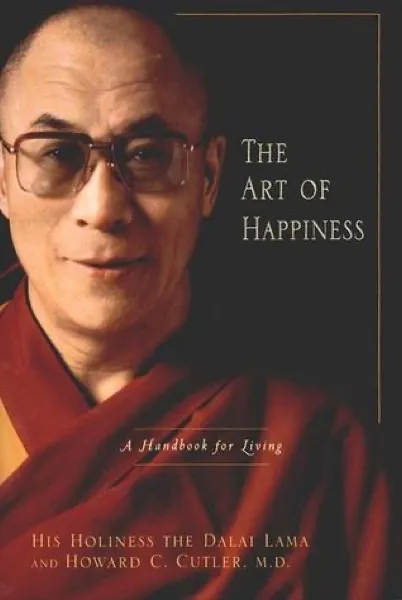
📚 The Art of Happiness: A Handbook for Living
Genre: Non-Fiction, Self-Help, Philosophy, Spirituality Originally Published: 1998
💭 Quick Summary & Thoughts
It’s a beautiful book. I’ll say that from the outset.
Happiness is one of those topics that’s been written about endlessly, and yet, it’s still not really something anyone understands. Everybody wants to be happy, but very few people actually know how. The poor are unhappy. The rich are unhappy. I picked this book up genuinely wanting to read about what the answer is. The unfortunate spoiler? Nobody knows. There’s no clean formula. What the book offers instead is a framework - things that tend to make people unhappy that you can try to avoid, and ways to lead a better, more intentional life.
I really like how the Dalai Lama approaches life and serious questions in general. There’s a calmness and clarity to his answers that makes you slow down and actually consider what he’s saying. And Howard Cutler does an excellent job of staying true to the Dalai Lama’s perspective while weaving in his own Western, psychological lens. That mix - Eastern spiritual wisdom and Western clinical perspective - is really what makes this book work. It’s not preachy, and it’s not overly academic either. It sits in a sweet spot between the two.
This is one of those books I think you keep coming back to. Over and over, every time you feel stuck. I don’t think anyone can fully grasp and internalise everything in it on a single read - maybe not even on two reads, lol. There’s just too much to absorb. Some of it lands instantly, some of it you only really understand after life forces you to.
The core ideas are simple but hard to actually live by. Once your basic needs are met, the rest is mostly frills. Material possessions don’t bring lasting happiness. The friendships and connections in your life matter far more than the next thing you can buy. And maybe the most universal one of all - most of our unhappiness comes from comparing ourselves to others. Easy to say. Genuinely hard to internalise.
If you’re looking for the answer to happiness, you won’t find it here. If you’re looking for a thoughtful, grounded perspective on how to suffer a little less and live a little better, this is a great place to start.
⚠️ Spoiler Zone
🚨 Click to reveal spoilers 🚨
The structure of the book is interesting in itself. Cutler positions himself almost as a student-interviewer, posing questions and dilemmas from a Western psychiatric perspective, and the Dalai Lama responds with a mix of Buddhist philosophy, personal anecdote, and surprisingly practical observation. What I appreciated is that Cutler doesn’t just transcribe the answers - he reflects on them, sometimes pushes back, and often shares cases from his own clinical practice that either confirm or complicate what the Dalai Lama has said. That dialogue format keeps it from feeling like a lecture.
The big underlying argument is that happiness is a skill, not a circumstance. It can be cultivated through training the mind, the same way you’d train any other capacity. That’s a reframe I hadn’t fully considered before - we tend to think of happiness as something that happens to us when conditions are right, but the book makes a strong case that it’s actually something you build. Slowly, deliberately, over time.
What I found particularly thought-provoking was the section on dealing with people who hurt you. The Dalai Lama’s framing - that hatred is the biggest obstacle to your own happiness, more than anything the other person has done to you - is hard to argue with even when it’s hard to live by. Patience and tolerance toward people who have wronged you isn’t about letting them off the hook; it’s about not letting them keep occupying space in your mind rent-free. That’s a more selfish framing than the book uses, but it’s how it landed for me.
The one thing I’d say is that some chapters cover ground that has been retread a hundred times in self-help literature since this book came out. Reading it in 2026 means a lot of the ideas feel familiar - because they’ve been borrowed and rephrased by every other book in the genre. But it’s worth remembering this book was published in 1998. A lot of what feels familiar now started here. It’s still the cleaner, more thoughtful version of those ideas than most of what came after.
🧠 Key Takeaways
-
Happiness is a skill, not a circumstance. It can be developed through deliberate mental training, the same way you’d build any other skill. It’s not something that happens to you when life lines up - it’s something you build, slowly and intentionally, regardless of what’s happening around you.
-
Inner state matters more than external conditions. Once your basic survival needs are met, your level of happiness is driven far more by your state of mind than by your circumstances. This is why both the rich and the poor can be deeply unhappy - the external conditions weren’t the deciding factor in the first place.
-
Comparison is the thief of joy. Most unhappiness doesn’t come from what we have or don’t have - it comes from measuring ourselves against others. There will always be someone with more. The way out is not to compete harder, but to stop running the comparison at all.
-
Hatred hurts you more than the person you hate. Carrying anger and resentment toward people who have wronged you is one of the biggest obstacles to your own happiness. Patience and tolerance aren’t about letting them off the hook - they’re about reclaiming your own peace.
-
Take initiative in relationships. Most of us wait for others to reach out, to be warm first, to make the effort. That waiting becomes a barrier and feeds isolation. Be the person who reaches out first - the gain in connection is almost always worth the small cost of going first.
-
Material possessions are frills, not foundations. Beyond meeting basic needs, more stuff doesn’t translate to more happiness. The energy spent chasing the next thing is energy not spent on what actually moves the needle - relationships, meaning, contribution.
-
Compassion is practical, not just noble. Caring about other people’s well-being isn’t a sacrifice - it’s one of the most reliable ways to feel better yourself. The wiring of the brain seems to reward connection and empathy. You’re not being virtuous; you’re being efficient.
-
You won’t get it all in one read. This is a book you come back to. Some ideas will land immediately. Others won’t make sense until life puts you in a situation where they suddenly do. That’s a feature, not a bug.
💬 Quote Corner
“I believe that the very purpose of our life is to seek happiness. That is clear. Whether one believes in religion or not, whether one believes in this religion or that religion, we all are seeking something better in life. So, I think, the very motion of our life is towards happiness.”
“If you can learn to develop patience and tolerance towards your enemies, then everything else becomes much easier.”
“I think that in many cases people tend to expect the other person to respond to them in a positive way first, rather than taking the initiative themselves to create that possibility. I feel that’s wrong, it leads to problems and can act as a barrier that just serves to promote a feeling of isolation from others.”
⭐ Ratings
| 📊 Plot | |
| ⚡ Pacing | |
| 👥 Characters | N/A |
| ✍️ Writing Style | |
| 🎯 Overall |