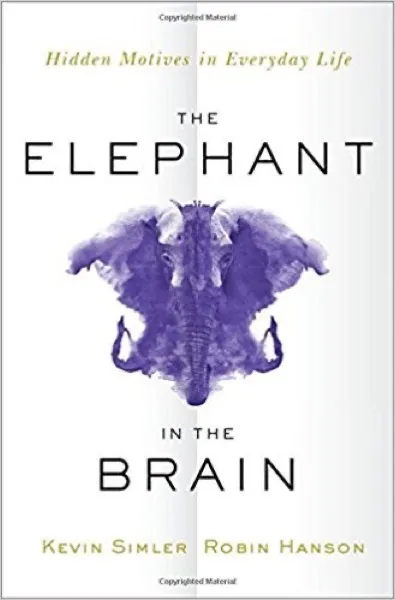
📚 The Elephant in the Brain: Hidden Motives in Everyday Life
Genre: Non-Fiction, Psychology, Science, Behavioural Economics Originally Published: 2017
💭 Quick Summary & Thoughts
Here’s the uncomfortable premise this book runs on: the reasons you give for the things you do are usually the second most honest answer available. There’s a polished one you tell the world, and a truer one underneath that you’ve quietly hidden, often from yourself. That gap is the elephant in the brain, and once it’s pointed out to you, you start seeing it everywhere.
This is one of the better non-fiction books I’ve had the privilege of reading. It walks through the biases and self-deceptions our brains run on, and how those quietly shape not just our individual behaviour but our social norms at large. It’s the kind of book you read to become a little more aware of yourself, so you can catch the moment when your actions are being driven by clean logic versus some other, less flattering desire you’d rather not admit to.
It came to me as a recommendation from a colleague at work, and I completely get why. This is exactly the genre I love, books that dig into how the brain actually functions, and crucially, ones that don’t just float clever conjectures but back them up with real experiments. The authors make their case with evidence, not vibes. And I really appreciated their self-awareness: they openly admit that their own motives for writing the book weren’t purely altruistic either. Hard not to respect a book on hidden motives that turns the lens on itself.
If you enjoy having your own behaviour gently dismantled and explained back to you, this one’s a treat. Fair warning though: you can’t un-see it afterward.
⚠️ Spoiler Zone
🚨 Click to reveal spoilers 🚨
There’s so much to like here, but the one thing I’ll remember forever is the split-brain experiment the authors describe. In patients who’ve had the left and right hemispheres surgically disconnected (for medical reasons), you can show each eye a different image, and only one hemisphere sees each one. So they flash a chicken to one side and a wintry/ice scene to the other, then ask the person to point to a related word. The hand controlled by the “ice” hemisphere picks shovel (ice → shovelling snow). Fair enough. But then they ask the person to explain why they chose shovel, and since speech is largely a left-brain function, and that side only saw the chicken, they confidently answer something like “well, you need a shovel to clean out the chicken coop.” The brain just invents a coherent reason on the spot.
Same with another version: they whisper an instruction in one ear to get up and leave the room, and the person does it. Ask them why, and instead of “I don’t know,” they’ll say “oh, I was going to grab a drink.” Our brains are extraordinarily good at retroactively explaining our actions. They almost never accept “no particular reason” as an answer. Self-deception at its absolute peak. And I find this so profound, because being aware of the phenomenon, you can actually introspect better, walking back through exactly why you made a decision and catching the moments where you’re just rationalizing after the fact. There’s a line in the book that captures it perfectly: there are two reasons we do anything, a good reason, and the real reason.
From there the book branches into different domains of life and shows how social signalling quietly runs the show in each, art, medicine, schooling, and more. The healthcare chapter floored me. The insight that spending more on medical care often doesn’t lead to better health outcomes is genuinely mind-blowing, and it’s backed by the experiment where medications were subsidised by different amounts for different participants. They also explain why we feel the compulsion to spend more on healthcare anyway, not because it makes us healthier, but because we want to be seen to have done everything possible. The story of the medication the king received hits especially hard.
Then there’s the chapter on charity, and how giving is so often less about the cause and more about being seen as the kind of person who gives. Donations are almost never anonymous, and they conspicuously bunch up right at the boundaries between giving tiers, just enough to clear the next visible threshold.
The book applies the same lens to a whole string of other domains, and a few stuck with me. The chapter on conversation was a favourite: the argument that we don’t really talk to exchange information so much as to show off that we have it, broadcasting that we’d make a knowledgeable ally or mate, which is why people are often more eager to speak than to listen. The chapter on consumption makes the case that a lot of what we buy is bought to be seen, not used. And the closing chapters on religion and politics land the point hardest: religious practice is read as a costly signal of community loyalty and commitment, and a great deal of political behaviour, voting, arguing, signposting our positions, is less about actually changing outcomes (your single vote won’t) and more about advertising which tribe you belong to. Different domain each time, same elephant underneath.
Finally, the authors tie it together with how these behaviours and self-deceptions evolved because they pay off socially. When someone’s sick and you bring them food, you’re signalling that you’ll show up for them in the bad times, in the hope they’ll do the same for you. And from the receiving end, having a crowd of people turn up to help you is itself a marker of your social standing. The hidden motive isn’t a bug; it’s the whole point.
🧠 Key Takeaways
-
We have hidden motives, and we hide them from ourselves first. A large share of our behaviour is driven by selfish, strategic motives, status, sex, loyalty, reputation, that we’d rather not acknowledge. The cleanest way to keep them hidden from others is to keep them hidden from ourselves, so we genuinely believe the prettier story.
-
Self-deception is a feature, not a flaw. Evolution didn’t make us self-aware truth-seekers; it made us convincing social actors. You’re a better liar when you believe your own lie, so the brain is built to obscure our real motives even from our conscious mind.
-
Your conscious mind is a press secretary, not a president. It doesn’t make the decisions, it explains them after the fact and spins them favourably. Introspection feels like it reveals our true reasons, but a lot of the time it’s just plausible-sounding PR generated after the choice was already made.
-
So much of behaviour is signalling. We don’t just consume, learn, give, or heal, we show that we’re doing it. A huge amount of everyday action is about broadcasting traits (wealth, intelligence, loyalty, health, virtue) to the people watching, whether or not we’d ever phrase it that way.
-
The best signals are the expensive ones. A signal only works if it’s hard to fake, so we gravitate toward costly displays, time, money, effort, risk, precisely because cheap talk proves nothing. It’s why difficult, wasteful, or sacrificial behaviour so often reads as sincere.
-
Conversation is showing off more than informing. We like to think we talk to exchange information, but the authors argue we mostly talk to advertise that we have information, to prove we’d make a knowledgeable ally or mate. It’s why we’re all far more eager to speak than to listen.
-
Medicine is as much about conspicuous care as it is about health. More medical spending doesn’t reliably produce better health outcomes, yet we keep reaching for more. Why? Because medicine lets us show others (and a sick loved one) that we did everything we could. It’s caring made visible.
-
Education is heavily about signalling, not just learning. A large part of what schooling certifies isn’t knowledge but desirable traits, intelligence, conscientiousness, conformity, that employers want a credential to vouch for. The diploma signals as much as the syllabus teaches.
-
Charity is often about the giver, not the cause. Giving is rarely anonymous, frequently bunches right at visible tier boundaries, and tracks how good it makes the donor look more than how much good it does. What looks like pure altruism is usually altruism plus an audience.
-
Religion and politics run on loyalty signalling. Costly religious rituals work as honest signals of community commitment, and political behaviour, voting, arguing, flying the flag, is less about changing outcomes (a single vote’s impact is essentially zero) than about advertising which tribe you belong to. The value of a belief often comes from convincing others you hold it, not from acting on it.
-
Awareness is the actual payoff. None of this is an excuse to be cynical. The value is practical: once you know the brain rationalizes after the fact, you can interrogate your own decisions more honestly, and design institutions that work with our hidden motives instead of pretending they don’t exist.
💬 Quote Corner
“A man always has two reasons for doing a thing: a good reason and the real reason.”
“The self acts less like an autocrat and more like a press secretary. In many ways, its job—our job—isn’t to make decisions, but simply to defend them. ‘You are not the king of your brain,’ says Steven Kaas. ‘You are the creepy guy standing next to the king going, “A most judicious choice, sire.”’”
“The takeaway from all these observations is that our species seems, somehow, to derive more benefit from speaking than from listening.”
⭐ Ratings
| 📊 Plot | |
| ⚡ Pacing | |
| 👥 Characters | N/A |
| ✍️ Writing Style | |
| 🎯 Overall |