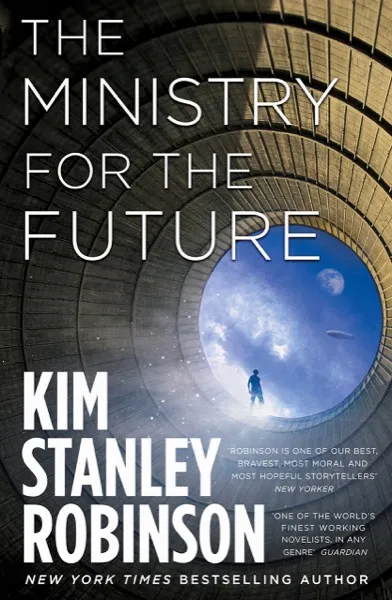
📚 The Ministry for the Future
Genre: Science Fiction, Climate Fiction, Speculative Fiction Originally Published: 2020
💭 Quick Summary & Thoughts
I’ll be honest - I was genuinely excited going into this one. Climate change is the defining challenge of our time, and the premise of a UN agency tasked with fighting for future generations felt like exactly the kind of speculative fiction that could say something real and urgent. And for a brief, brilliant moment, the book delivers on that promise.
The opening chapter set in Uttar Pradesh during a catastrophic wet-bulb heat wave is one of the most viscerally powerful pieces of climate writing I’ve come across. It’s not theoretical. It’s not abstract. It puts you in a lake surrounded by dying bodies and makes you feel the heat, the helplessness, the scale of it. I was hooked.
And then… the book kind of loses me.
What follows is Robinson’s vision of how humanity might respond - and it’s… optimistic. Aggressively, almost defiantly optimistic. And look, I want to believe it. Truly. But my brain just wouldn’t let me go there. We’re talking about the same species that can’t agree on a budget, that has spent centuries entrenching caste hierarchies and gender inequality - and we’re supposed to accept that a climate catastrophe reshuffles all of that? I’m too cynical for that particular brand of hope.
There are two structural choices that really frustrated me. First, the scientific deep-dives. I get it, glacial geoengineering is a real and fascinating idea - pump the water from underneath the glacier so it refreezes on top. Cool. I do not need three chapters of mechanics and fluid dynamics to understand that. I don’t even fully follow it all when Robinson really gets going, and I certainly didn’t need to.
Second - and this one hit especially hard on the audiobook - the scattered short chapters where the narrator becomes an abstract concept. I am a carbon atom. I am a photon. I am market. I see what Robinson is going for, a kind of literary device to zoom out and shift perspective. But in practice? Jarring. Disorienting. A string of random facts followed by a declaration felt more like padding than poetry.
That said, there’s a category of chapter that I genuinely loved: the human vignette chapters. A village in Africa adapting to a new climate reality. Workers in a mine. People in refugee camps. These are short, self-contained, and they don’t connect to the main plot either - but unlike the “I am carbon” chapters, they add something. They give the reader perspective, empathy, texture. They make the crisis feel real in the way statistics never can.
The policy ideas Robinson floats are genuinely interesting and worth thinking about. As a piece of speculative policy-making, the book has real value. As a novel, it’s more uneven.
Decent book. Great ambitions. Structural issues that hold it back.
⚠️ Spoiler Zone
🚨 Click to reveal spoilers 🚨
The two main characters - Mary Murphy, head of the Ministry, and Frank May, the traumatized American survivor of the Uttar Pradesh heat wave - are the emotional anchors of the book, and Robinson does a decent job with both. Frank’s arc, going from shell-shocked survivor to something of a rogue operative, is interesting. Mary’s gradual radicalization, from diplomatic pragmatist to someone quietly tolerating eco-terrorism, is the most nuanced character development in the book.
The Children of Kali subplot - an eco-terrorist group that starts targeting airlines and the ultra-wealthy - is where things get the most morally complicated and, honestly, the most interesting. The question of whether violence is ever justified to prevent mass extinction is not one Robinson fully answers, but raising it is worthwhile.
The carbon coin ultimately succeeds in the book’s world, backed by central banks and creating a financial incentive to sequester carbon. It’s a fascinating idea, and the economic chapters, as dry as they sometimes get, at least feel grounded in real mechanisms.
The ending wraps up a little too neatly for my liking. There’s genuine progress, species are recovering, emissions are down. After 500 pages of complexity and crisis, it felt like Robinson wanted to leave readers with hope - and I respect that intention - but it stretched my credulity more than anything else in the book.
🧠 Key Ideas & Proposals
The book functions almost as a speculative policy manifesto in places. Some of the ideas Robinson floats are genuinely worth knowing about:
-
The Carbon Coin. A cryptocurrency backed by sequestered carbon, issued by central banks as legal tender. The idea is to make it financially rational to not burn carbon, by paying people more to leave it in the ground. Genuinely clever as an economic mechanism.
-
Carbon Quantitative Easing. Central banks underwriting the carbon coin through their balance sheets, essentially treating carbon sequestration like a sovereign bond. The argument is that the financial tools already exist - we’re just not deploying them for the right goals.
-
Half Earth. Rewilding 50% of the planet’s surface to allow biodiversity to recover. Half for humans, half for everything else. Ambitious to the point of seeming impossible, but the ecological logic is sound.
-
Glacial Geoengineering. Pumping meltwater from beneath glaciers to the surface so it refreezes, slowing the glaciers’ slide toward the sea. The technical detail Robinson goes into here is… extensive. But the core idea is real and being studied.
-
Degrowth Economics. The book advocates heavily for localized economies, the death of mass air travel, and a reimagining of what prosperity looks like. Less GDP obsession, more wellbeing metrics.
💬 Quote Corner
“The world economy was an energy system, and as such it was governed by the laws of thermodynamics and the other physical laws pertaining to energy systems. This was not a perspective that economists had ever adopted.”
“The Ministry for the Future’s job was to represent the interests of future generations of all living creatures. This was their only purpose.”
“No one wants to hear about the slow catastrophe. Everyone wants to hear about the event.”
⭐ Ratings
| 📊 Plot | |
| ⚡ Pacing | |
| 👥 Characters | |
| ✍️ Writing Style | |
| 🎯 Overall |